

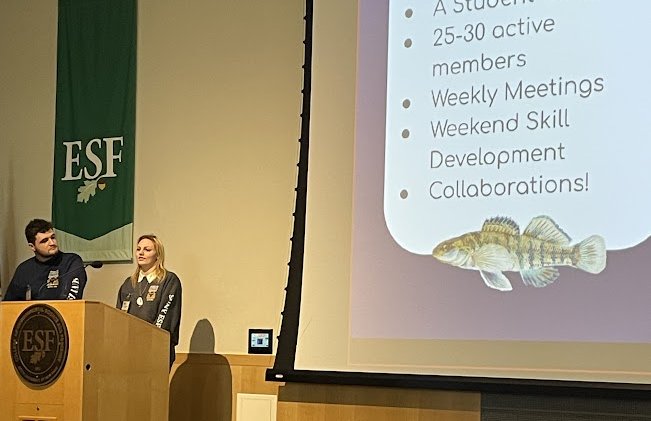
 The SUNY College of Environmental Science and Forestry (ESF) held its first annual meeting of their University Chapter of the American Fisheries Society. Their motto, “No Fish too Big, No Macroinvertebrate too Small”, perfectly encapsulated the diversity of participants, speakers, supporters and guests. Presenters ranged from worldwide business leaders like Innovasea to first year environmental science students. Community Science Institute (CSI) was proud to be a bronze level supporter of the student-organized meeting. Alyssa Johnson and Jared Thomas represented CSI at the meeting on December 5, 2025.
The meeting kicked off with plenary speaker and Canadian biologist, Dr. Steven Cooke, who delivered an engaging and motivating address. He urged students and professors to embrace diverse perspectives, collaborate across disciplines, and seek knowledge from every source. Dr. Cooke highlighted several papers he had co-authored, as well as other collaborative projects, demonstrating how bringing in other views can assist in forming a more solid scientific solution. Cooke made students aware of life outside of college, where they will be asked to do tasks and work with people outside their field or experience. He compared this new challenge to the first biologists and founders of their fields, men and women who were required to be multifaceted in their studies and skills and who paved the way for specialization within environmental studies.
Following Dr. Cooke’s speech, participants were encouraged to select from a variety of presentations to attend. Talks ranged from enthusiastic student projects, to informative professor lessons, and to displays of new technologies. Each one offered a glimpse into the fisheries and water quality world.
Unfortunately we were not able to attend every talk, however those we attended offered glimpses into the wide array. We heard from a professor about the importance of ethical treatment of vertebrate lifeforms for research and testing. We attended several student presentations covering topics from the stomach contents of yellow perch to how beaver dams affect vegetation. We also heard from several conference supporters, presenting new technology and innovations in fish and wildlife monitoring.
CSI representatives, Alyssa and Jared, spoke with several students and staff during the poster and tabling session. They discussed CSI’s mission of inspiring and empowering communities to safeguard water resources by cultivating scientific literacy through volunteer water quality monitoring, certified laboratory analyses, and education. Alyssa and Jared shared their own stories about their experiences in the fields of research and environmental science. Many students were excited as well as curious about getting involved with CSI’s mission. While some were hopeful at potential employment opportunities, others were engaged in seeing an organization dedicated to community science so close to home.
The future looks bright for the world of environmental science with these eager minds entering the field. CSI was fortunate to participate and support, bringing home the event’s message of diversity and interdisciplinary research. Here at CSI, we encounter this each day, with every water sample dropped off, every harmful algal bloom reported by our volunteers, and every excited volunteer identifying benthic macroinvetebrates during open lab nights. Each moment, different members of the community contribute however they can and regardless of their background, all in pursuit of cleaner water and a safer environment.
Jared Thomas is a first-year student at Ithaca College in the Writing Program, and comes to CSI as a Federal Work-study Student. Originally from Wisconsin, Jared moved to New York in the summer of 2025 to begin his college career.
Leave a Comment