

CSI’s Outreach & Programs Coordinator, Alyssa Johnson, collects a sample from Cliff Brook Park on 4/23/26.
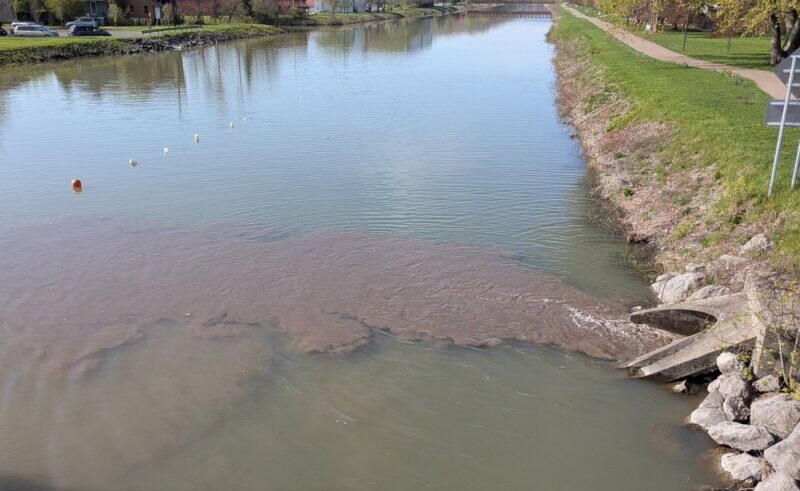
On April 23, CSI received an email from a concerned community member who had noticed a cloudy, dark brown discharge flowing into the Cayuga Inlet in the City of Ithaca. Within two hours, our team mobilized. Armed with sample bottles, CSI’s Outreach & Programs Coordinator, Alyssa Johnson, rushed to the Inlet. At the site, Alyssa observed highly turbid (i.e. cloudy) water flowing from Cliff Park Brook, a small tributary that drains through a culvert and into the Cayuga Inlet. She traced the issue upstream, where recent dredging activity appeared to be the likely source. Alyssa collected multiple samples and documented field conditions, including the absence of visible erosion controls and the presence of disturbed sediment. These samples were brought back to CSI’s lab the same day for analysis.
Upon returning to the lab, Alyssa worked with our partners to escalate the issue. She advised the community member who initially contacted us to report the discharge to the DEC. She also reached out to our partners at the Tompkins County Soil and Water Conservation District to make them aware of the discharge. When we didn’t hear back from the reporting community member in a timely fashion, Alyssa moved forward with contacting DEC herself to be certain that the incident was addressed by the proper authorities. In response, a DEC officer investigated the site, identified a violation related to the City of Ithaca’s work, and issued an administrative penalty.
By coincidence, CSI’s Synoptic Stream and Lake Monitoring Program volunteers had a scheduled monitoring event on the Cayuga Inlet that same day. This allowed us to pair targeted investigative samples with our broader set of 24 routine samples from the Inlet, giving us a more complete picture of water quality conditions and how the discharge may have affected downstream areas. While laboratory results are still pending, this alignment of community reporting and ongoing monitoring will significantly strengthen our ability to understand the impacts of this discharge. Once laboratory testing is complete, the results from the sampling, including the investigative discharge results, will be available on our public water quality database.
This story highlights how CSI’s model works in practice. A community member noticed something unusual and trusted CSI to respond. We acted quickly, leveraging our scientific expertise, volunteer network, and lab capacity to investigate. We collaborated with local partners to ensure accountability and regulatory follow-through. We are continuing to analyze the data to better understand impacts and help prevent similar issues in the future.
In just one day, a single observation became a coordinated, community-driven response, demonstrating the power of accessible science, strong partnerships, and public trust in our shared efforts to protect Cayuga Lake, a critical source of drinking water for over 40,000 people in our community.
If You Witness a Violation of Environmental Conservation Law
Reports from community members are vital for effective enforcement of New York’s environmental laws. There are more than 300 Environmental Conservation Police Officers (ECOs) and Investigators in New York State, each patrolling an average of 400 square miles. You can help by reporting every Environmental Conservation Law (ECL) violation that you observe or suspect. To ensure a prompt response to your complaint, please be prepared to provide detailed information when reporting a violation of law. Visit the New York State Department of Environmental Conservation Law’s website for more information.

Leave a Comment