Community Science InstituteCommunity Science InstituteCommunity Science InstituteCommunity Science Institute
  • Get Involved
    • Volunteer With Us!
    • Monitoring Partnerships
      • Harmful Algal Bloom Monitoring on Cayuga Lake
      • Synoptic Sampling
      • Biological Monitoring
      • Owego Creek Tributaries Monitoring Project with Trout Unlimited
      • Past CSI Monitoring Programs
        • Red Flag Monitoring
    • Outreach and Education
      • Journey of Water
        • Learning Materials
      • CSI News and Monthly Updates
      • The Water Bulletin Newsletter
      • CSI’s Public Comments & Testimonies
      • Public Events and Presentations
      • Publications
  • I want to test my water
    • Potable and Non-Potable Water Tests & Fees
    • Water Testing FAQs
    • Instructions for Collecting and Submitting Water Samples
    • Drinking Water Resources for the General Public
    • Water Testing Assistance Program
  • CSI Water Quality Data
    • Database Home
    • Streams and Lakes Data
      • Cayuga Lake Region
      • Seneca Lake Region
      • Upper Susquehanna River Region
      • Select and Download Streams and Lakes Data
    • HABs Database
      • Select and Download Cayuga Lake HABs Data
    • Pre-Fracking Groundwater Baselines
      • Select and Download Groundwater Baselines
    • Biological Monitoring Results
    • Glossary
  • About Us
    • Meet Our Staff
    • Employment Opportunities
    • Meet Our Board of Directors
    • Annual Reports
    • CSI Frequently Asked Questions
    • Contact Us
    • CSI in the Media
  • Donate
    • CSI’s Business Membership Program
    • 2025-2026 Business Membership Partners

Harmful Algal Bloom Monitoring on Cayuga Lake

  • Synoptic Sampling
  • Red Flag Monitoring
    • Red Flag Monitoring Symposium
  • Biological Monitoring
    • BMI Results
  • Harmful Algal Bloom Monitoring on Cayuga Lake
    • Harmful Algal Bloom Datasets
  • Owego Creek Tributaries Monitoring Project with Trout Unlimited
  • Past CSI Monitoring Programs
Home Monitoring Partnerships Harmful Algal Bloom Monitoring on Cayuga Lake

Cayuga Lake Harmful Algal Bloom Monitoring Program

Resources for Community Members, Residents, and Visitors
  • HAB Interactive Map & Database
  • Subscribe to Cayuga Lake Watershed Network’s Weekly HABs Updates
  • NYHABs Map
  • NYSPark Beach Results Map
  • Dogs & Harmful Algal Blooms -New York Sea Grant
  • NYSDEC HABs Information Page
  • Harmful Blue-green Algae Blooms: Understanding the Risks of Piping Surface Water into Your Home
  • Harmful Algal Bloom Action Plan Cayuga Lake
In 2025, CSI—working with Seneca County Health Department, Cayuga County Health Department, and Tompkins County Whole Health—adopted a strategic, risk-based sampling framework focused on fourteen high-use and high-exposure priority sites around the lake. Volunteers conduct weekly shoreline surveys and deliver samples to CSI’s certified laboratory, producing rapid, public-facing results shared through CSI’s Interactive HABs Map and Water Quality Database. This collaborative, community-powered approach offers an effective, scalable model for science-based HAB monitoring across the Finger Lakes.

Since 2018, Community Science Institute has led a volunteer-driven, community-powered harmful algal bloom monitoring program around Cayuga Lake that blends rigorous science, open data, and strong local partnerships to ensure timely and accurate HAB reporting. Through consistent shoreline monitoring, CSI has built a long-term dataset that supports public health decision-making and informs potential lake management strategies. By uniting trained volunteer community scientists with certified laboratory analysis and close collaboration with county health departments, local nonprofit partners, and state agencies, the program demonstrates how sustained, community-driven science can generate reliable data, fill critical information gaps, and guide evidence-based action.

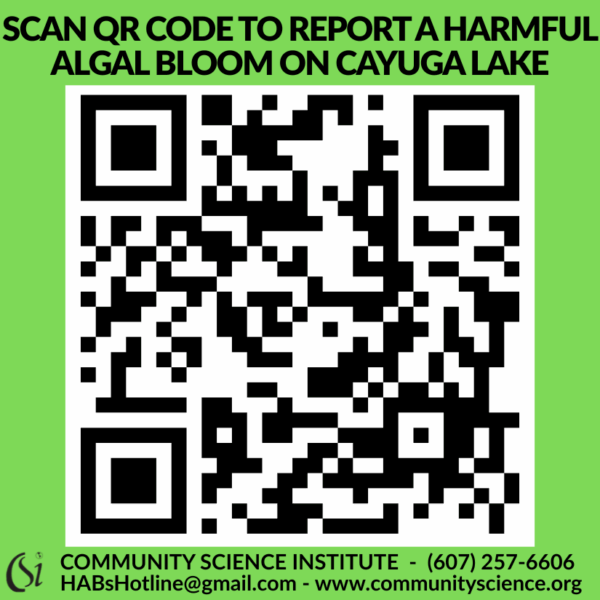
Have you observed a suspected HAB on Cayuga Lake?

If you observe a harmful a HAB on Cayuga Lake and are not one of CSI’s trained volunteers, you can submit a report using the 2026 Cayuga Lake Community HABs Report Form (the form will go live in spring/summer 2026).

Because HABs can form and dissipate rapidly, we encourage you to take several photos and submit your report the same day the bloom is observed, whenever possible. If you’d have additional questions or concerns, please send an email to HABsHotline@gmail.com.

Interested in becoming a new volunteer?

In an effort to increase community participation and Cayuga Lakes shoreline monitoring coverage as the program continues to grow, we recruit new volunteers on an annual basis. The monitoring season will begin in June, and you’ll be contacted in May to attend an annual volunteer orientation session. Please fill this brief form out to get started!

How to identify a HAB

HABs are caused by highly specialized, competitive, and ancient microscopic bacteria. These organisms are difficult to predict, challenging to remove once established, and some can produce toxins that pose risks to human, animal, and environmental health.

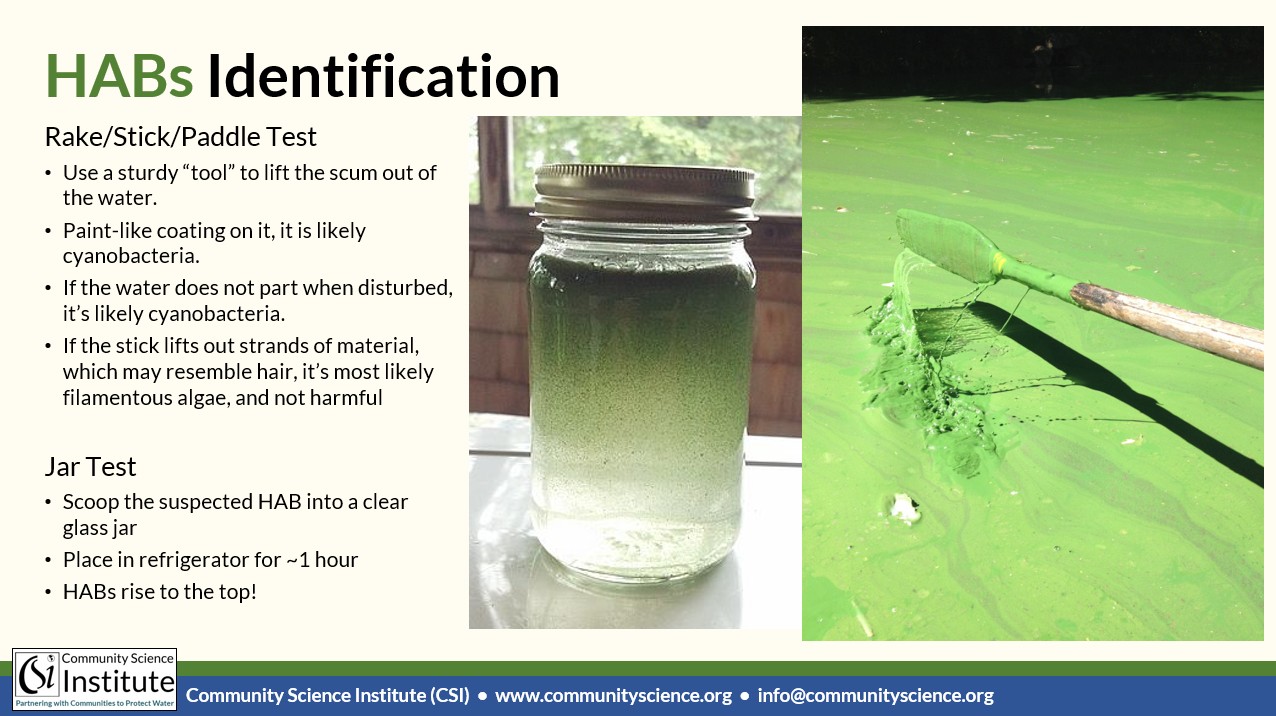
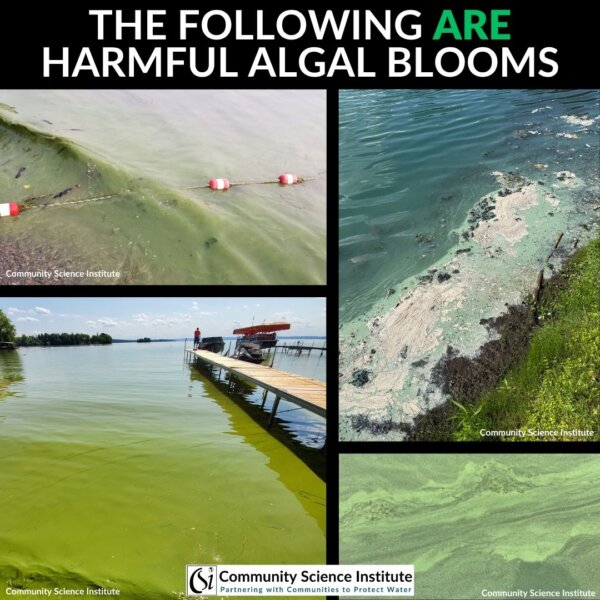
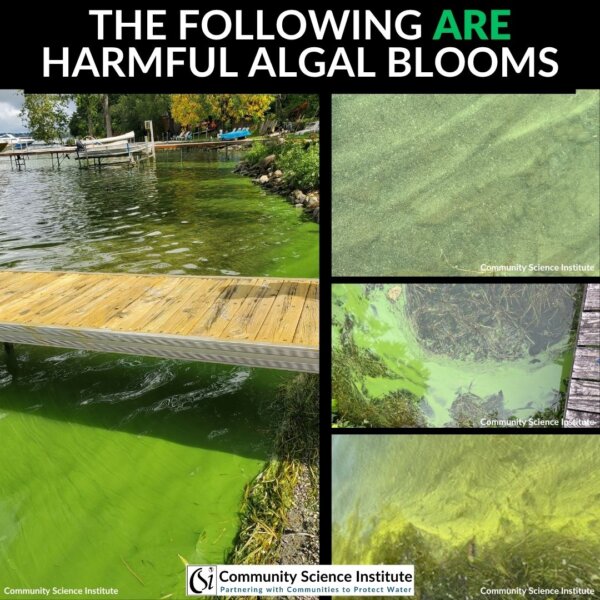
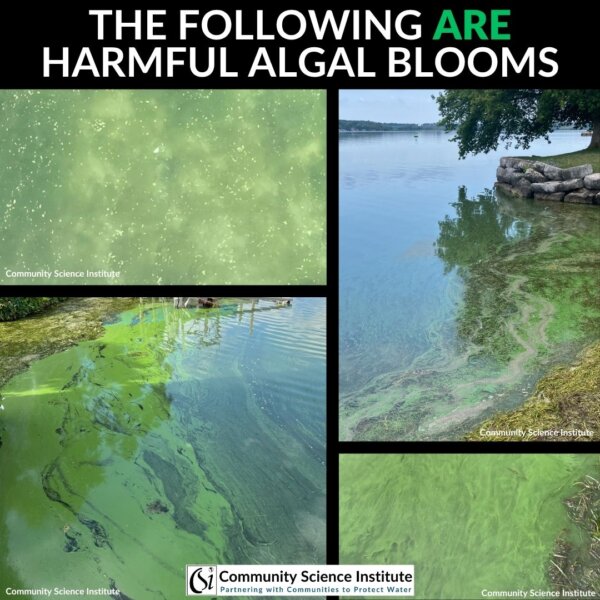
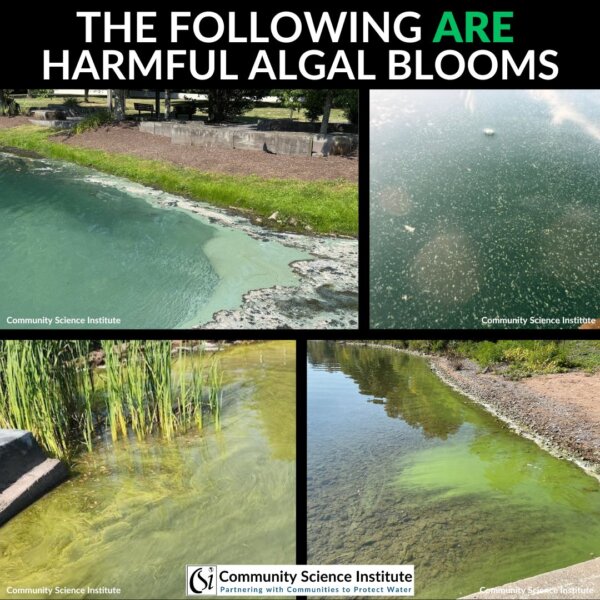
HABs can appear in several physical forms, including:

  • Floating surface blooms or thick scum
  • An oily or paint-like sheen on the water
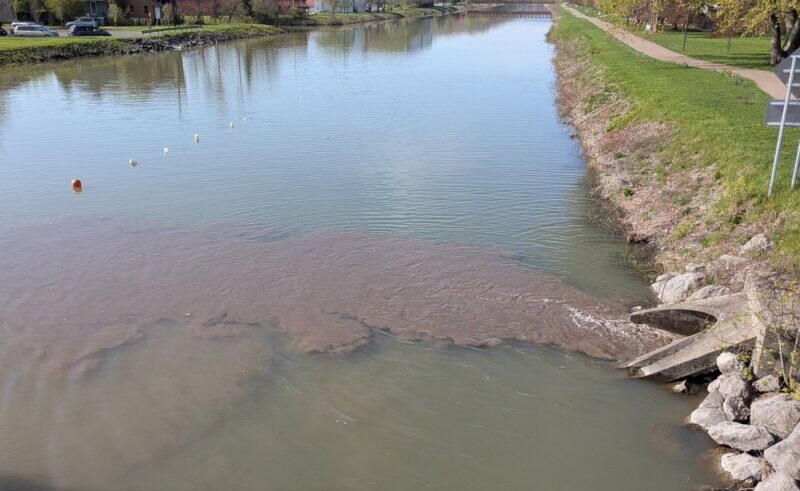
  • Foamy, marbled, speckled, or streaked patterns
  • A wide range of colors (often green, blue-green, or brown)
  • Floating clumps or mats
  • Accumulation along shorelines, docks, or structures forming a visible “scum line”

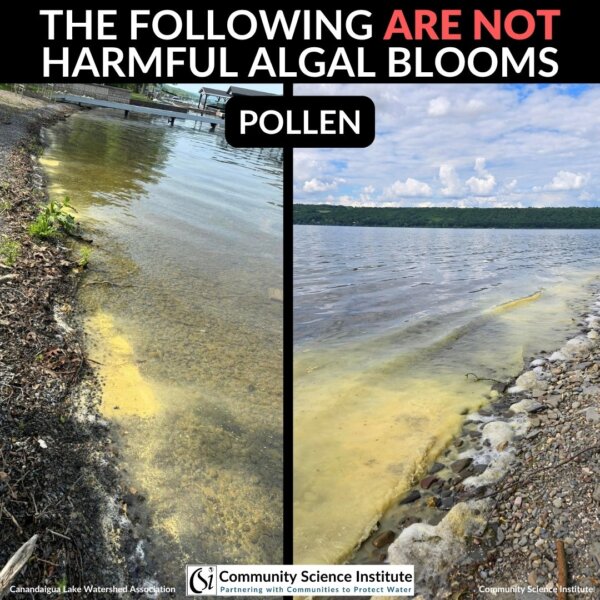
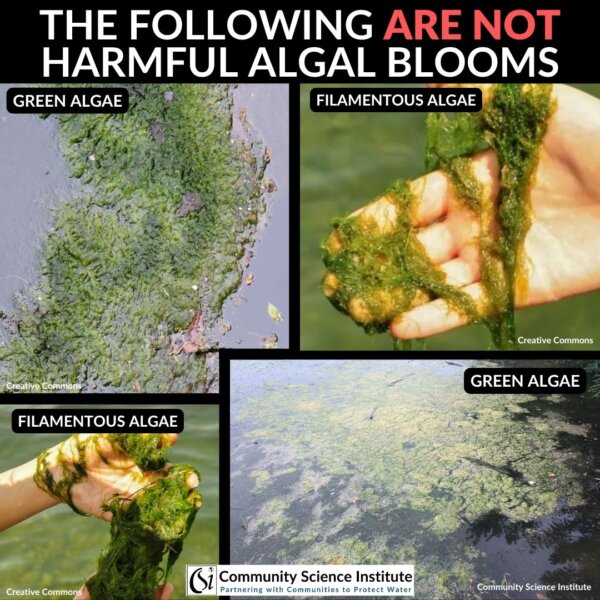
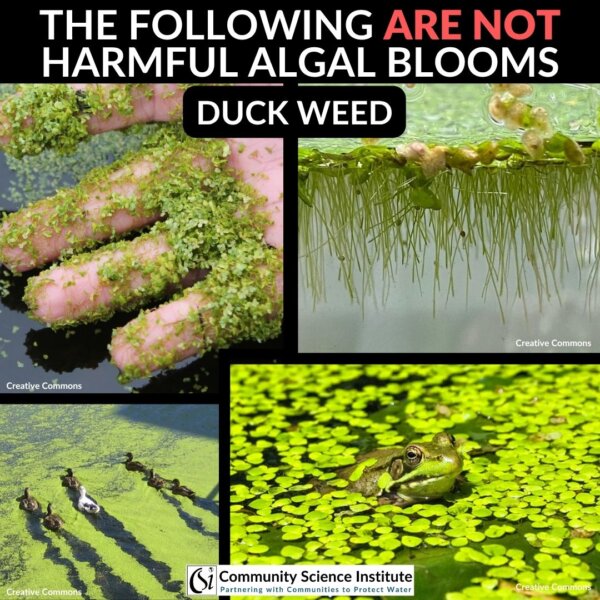
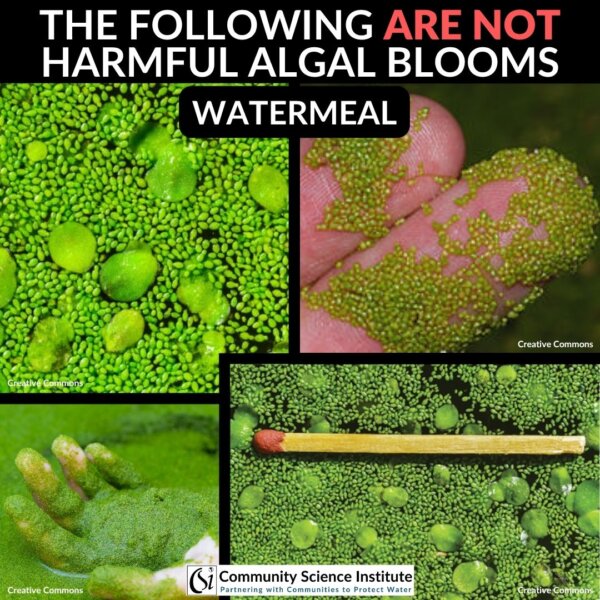
A simple “rake test” can help distinguish HABs from submerged aquatic plants—HABs often break apart or pass through the rake rather than coming up as intact plants.

The Community Behind the HABs Monitoring Program – The HABs Harriers & Carriers

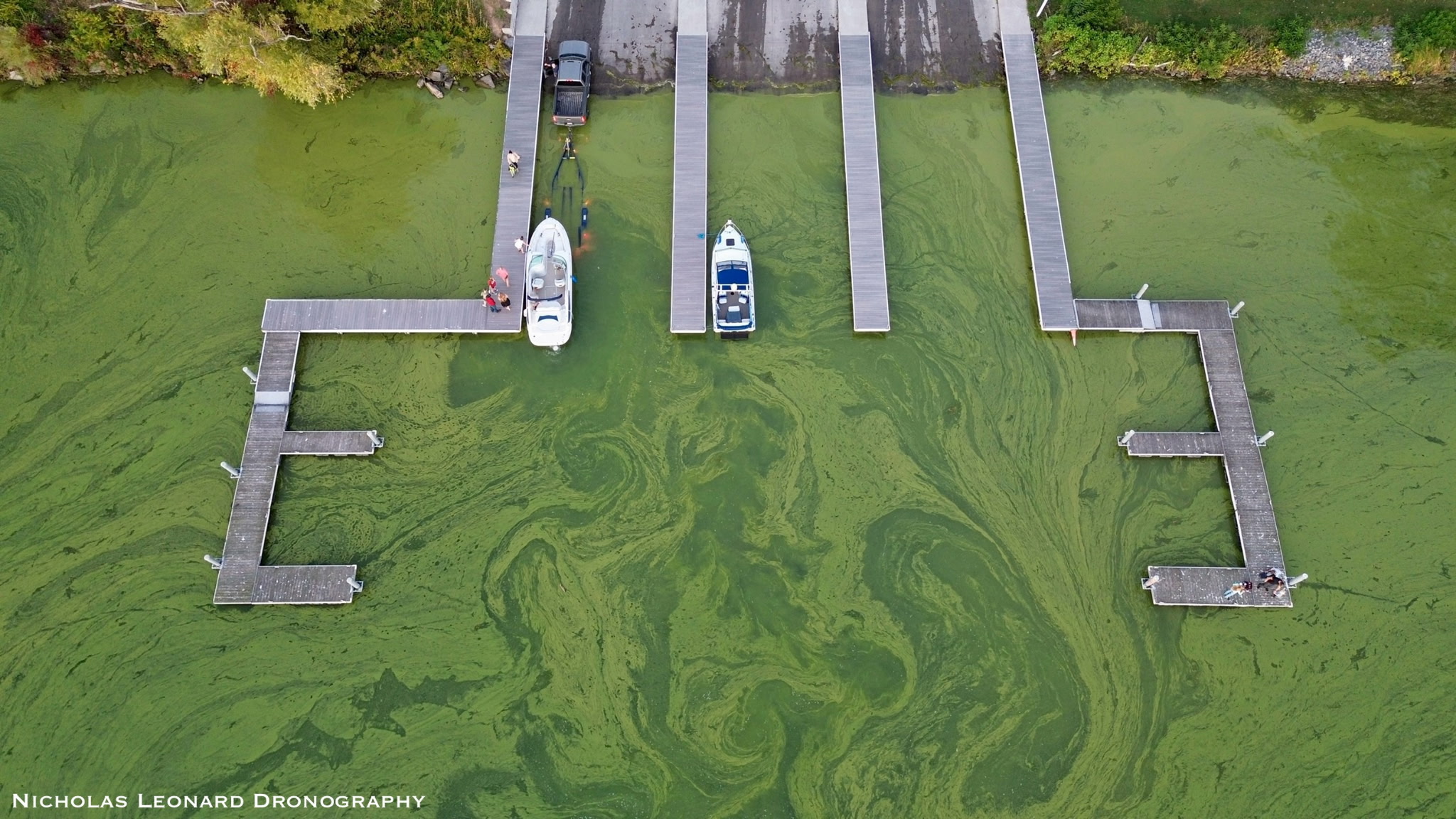
A drone image of Cayuga Lake, captured from the northern end of the lake looking south. 
Photo credit: Nicholas Leonard Dronography
A drone image of Cayuga Lake, captured from the northern end of the lake looking south. Photo credit: Nicholas Leonard Dronography

This program would not be possible without the dedication and collaboration of our volunteers, community members, and partners—Cayuga Lake Watershed Network, Discover Cayuga Lake, Nicholas Leonard Dronography, Cayuga County Health Department, Seneca County Health Department, Tompkins County Whole Health, and the New York State Office of Parks, Recreation and Historic Preservation—whose support made the 2025 season possible. Through your collective vigilance and commitment, we are learning not only when blooms occur, but how they behave—and how, together, we can continue to better understand and protect Cayuga Lake.

For more information about the 2025 season, please read the article “Reports vs. Reality: Refining How We Read Cayuga Lake’s Harmful Algal Blooms“ which is included in CSI’s 2025 Water Bulletin Newsletter.

Analyzing Harmful Algal Bloom Samples for Cyanobacteria

The CSI lab is equipped to perform three analyses on suspicious blooms: microscopy, total chlorophyll a, and microcystin. If initial inspection under the microscope confirms the presence of cyanobacteria, then chlorophyll a and microcystin analyses are performed.

  • Microscopy: All samples received by the CSI lab are first assessed by microscopy, carefully looking at samples under the microscope, to characterize general bloom composition and determine if cyanobacteria are present in the bloom.
  • Total Chlorophyll-a: If cyanobacteria are present, total chlorophyll a is used to estimate the biomass of the cyanobacteria bloom. Total Chlorophyll a is determined using spectrophotometry and results are reported in units of parts per billion (ppb) or micrograms/liter (ug/L).
  • Microcystin: Cyanobacteria produce a variety of natural chemicals, a few of which  are harmful to other species, including humans. The most common harmful chemical found in New York is microcystin.
    • Detailed toxicity studies have not been performed, and there is not yet a consensus on acceptable exposure levels. The New York State Department of Health (NYSDOH) has set safe limits for public drinking water supplies at 0.3 ug/L and for public swimming beaches at 4.0 ug/L (EPA, 2017). The New York State Department of Environmental Conservation (NYSDEC) defines a “bloom with high toxin” as 20 ug/L near the shore and 10 ug/L in open water (NYSDEC HABs Program Guide, Section 3).
    • Microcystin toxin is measured using EPA Method 546 which is an enzyme-linked immunosorbent assay (ELISA). CSI reports results down to the drinking water standard of 0.3 ppb (EPA, 2015).
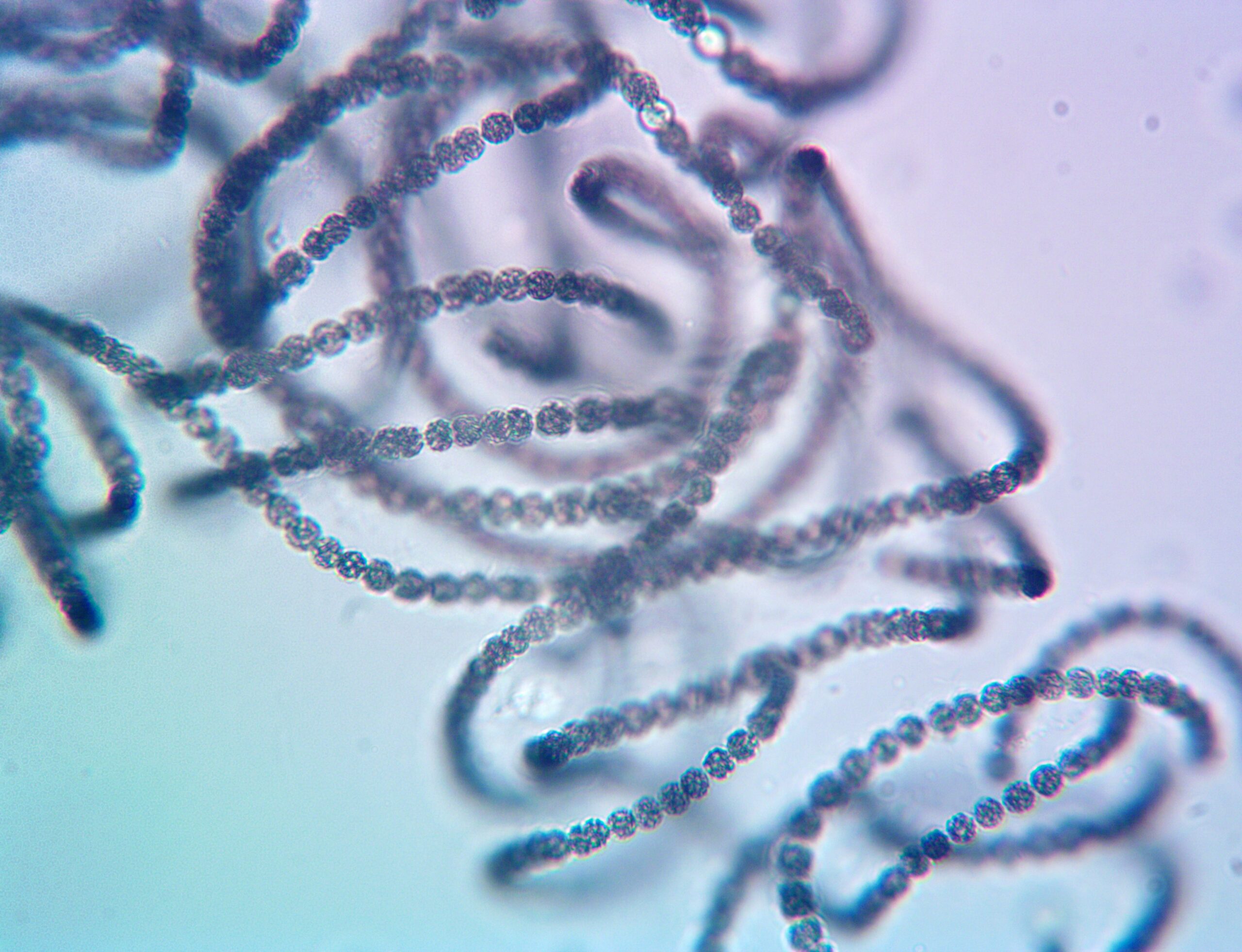
Dolichospermum sp.
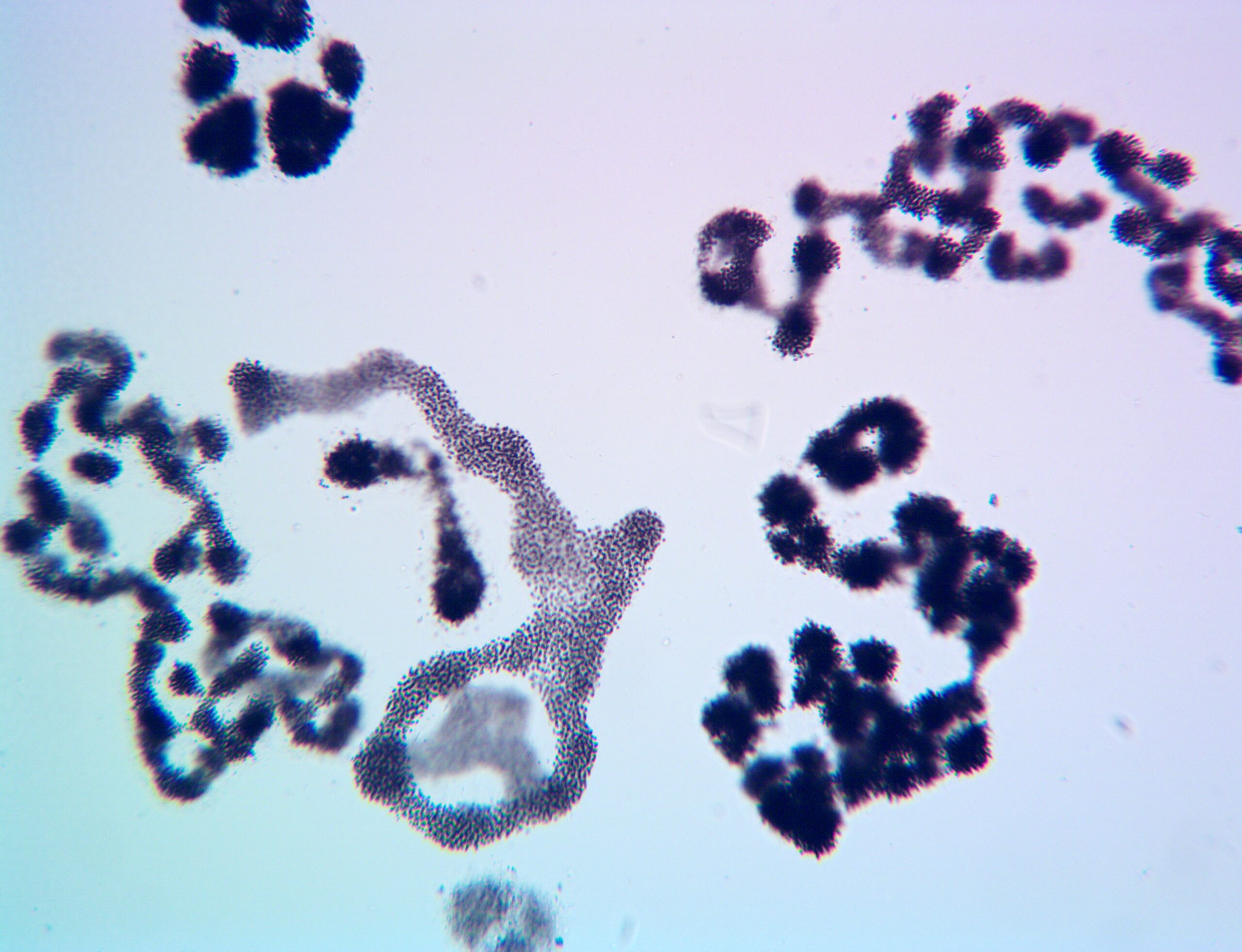
Microcystis sp.

Loading

Connect With Us

The Community Science Institute
Langmuir Lab Building, Box 1044
95 Brown Rd. Ithaca, NY 14850

(607) 257-6606
info@communityscience.org

Support Our Work

Donate

Recent Posts

  • Upcoming Harmful Algal Bloom Presentations

    What Lurks in the Lake? From Reports to Reality: Making Sense of

    5 February, 2026
  • CSI’s 2026 Data Jam: Investigating Local Water Quality

    Come with a question —or discover one on the spot— and take

    21 January, 2026
Copyright 2007-2025 Community Science Institute
  • Get Involved
    • Volunteer With Us!
    • Monitoring Partnerships
      • Harmful Algal Bloom Monitoring on Cayuga Lake
      • Synoptic Sampling
      • Biological Monitoring
      • Owego Creek Tributaries Monitoring Project with Trout Unlimited
      • Past CSI Monitoring Programs
        • Red Flag Monitoring
    • Outreach and Education
      • Journey of Water
        • Learning Materials
      • CSI News and Monthly Updates
      • The Water Bulletin Newsletter
      • CSI’s Public Comments & Testimonies
      • Public Events and Presentations
      • Publications
  • I want to test my water
    • Potable and Non-Potable Water Tests & Fees
    • Water Testing FAQs
    • Instructions for Collecting and Submitting Water Samples
    • Drinking Water Resources for the General Public
    • Water Testing Assistance Program
  • CSI Water Quality Data
    • Database Home
    • Streams and Lakes Data
      • Cayuga Lake Region
      • Seneca Lake Region
      • Upper Susquehanna River Region
      • Select and Download Streams and Lakes Data
    • HABs Database
      • Select and Download Cayuga Lake HABs Data
    • Pre-Fracking Groundwater Baselines
      • Select and Download Groundwater Baselines
    • Biological Monitoring Results
    • Glossary
  • About Us
    • Meet Our Staff
    • Employment Opportunities
    • Meet Our Board of Directors
    • Annual Reports
    • CSI Frequently Asked Questions
    • Contact Us
    • CSI in the Media
  • Donate
    • CSI’s Business Membership Program
    • 2025-2026 Business Membership Partners
Community Science Institute
X